 |
Aleph-w
1.9
General library for algorithms and data structures
|


|
|
Aleph-w
1.9
General library for algorithms and data structures
|
|
#include <htlist.H>
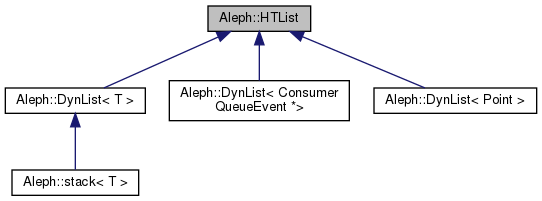
 Inheritance diagram for Aleph::HTList:
Classes | |
| class | Iterator |
Public Member Functions | |
| HTList () noexcept | |
| Initialize an empty list. | |
| void | reset () |
| bool | is_empty () const noexcept |
| bool | is_unitarian () const noexcept |
| bool | is_unitarian_or_empty () const noexcept |
| Slinknc * | get_head () const noexcept |
| Slinknc * | get_tail () const noexcept |
| Slinknc * | get_first () const noexcept |
| Slinknc * | get_last () const noexcept |
Return the last item of the list (nullptr if the list is empty) | |
| HTList & | swap (HTList &l) noexcept |
| Swap in constant time (very fast) 'this' elements with 'l' list elements Referenced by append(), insert(), reverse() and split_list(). More... | |
| void | insert (Slinknc *link) noexcept |
| void | append (Slinknc *link) noexcept |
| void | append (HTList &l) noexcept |
| void | put (Slinknc *link) noexcept |
| void | concat (HTList &l) noexcept |
| void | concat_list (HTList &l) noexcept |
| void | insert (HTList &l) noexcept |
| void | insert (Slinknc *link, HTList &list) noexcept |
| Slinknc * | remove_head_ne () noexcept |
| Slinknc * | remove_head () |
| Slinknc * | remove_first_ne () noexcept |
| Slinknc * | remove_first () |
| bool | remove (Slinknc *link) |
| void | push (Slinknc *link) noexcept |
| Slinknc * | pop () |
| Slinknc * | top () |
| size_t | split_list (HTList &l, HTList &r) noexcept |
| size_t | split_list_ne (HTList &l, HTList &r) noexcept |
| size_t | split (HTList &l, HTList &r) noexcept |
| size_t | reverse () noexcept |
| size_t | reverse_list () noexcept |
| void | cut (Slinknc *link, HTList &list) noexcept |
| It makes reference to is_empty(). Referenced by cut_list(). More... | |
| void | cut_list (Slinknc *link, HTList &list) noexcept |
| void | remove_all_and_delete () noexcept |
| size_t | size () const noexcept |
| void | rotate_left (size_t n) |
Single linked list of nodes.
HTList models a list of nodes of type Slinknc. A Slinknc object is a link that could be contained inside any data structure. The possibility for belonging to a HTList is defined for the owner of one o more objects of typeSlinknc`.
A HTlist object maintains two references. The first one is called head" and corresponds to the first node. The second one is called tail and corresponds to last node.
Take in account that this class does not manage memory neither access to the data that could be stored in the nodes. Slinknc y Snodenc. However, since this class is inherited by other more sophisticated classes, we will use the term "item" instead of node for referring an element of this list of nodes.
|
inlinenoexcept |
Insert link as last element
| [in] | link | New element that will be inserted |
Here is the caller graph for this function:
|
inlinenoexcept |
Join 'this' with 'l' through list end
| [in] | l | List that will be inserted through list end |
Here is the call graph for this function:
|
inlinenoexcept |
Concat to 'this' all 'l' list; 'l' becomes empty
|
inlinenoexcept |
This is an overloaded member function, provided for convenience. It differs from the above function only in what argument(s) it accepts.
It makes reference to is_empty().
Referenced by cut_list().
It cuts 'this' over 'link' element and it puts all remaining elements
| [in] | link | Element where 'list' will be cut. |
| [in] | list | List that will be cut in link |
This is an overloaded member function, provided for convenience. It differs from the above function only in what argument(s) it accepts.
|
inlinenoexcept |
Return list first element
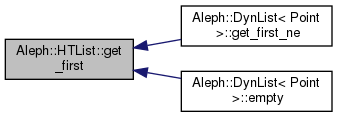
Here is the caller graph for this function:
|
inlinenoexcept |
Return list head (first element)
|
inlinenoexcept |
Return list tail (first element)
|
inlinenoexcept |
Insert link as first element
| [in] | link | New element that will be inserted |
Here is the caller graph for this function:
|
inlinenoexcept |
Insert starting in link (contained in 'this' list) the 'list' list. 'list' becomes empty
| [in] | link | Element where 'list' will start |
| [in] | list | List that will be inserted after link |
Insert a list into this after one of its items.
insert(link, list) assumes that link points to a item of this and inserts in constant time list just after the item pointed by link. The order of list is not altered. but list becomes empty after insertion.
Suppose the following situation
this-->t1-->t2-->t3-->t4-->t5-->t6-->t7-->t8
                ^
| link
l–>l1–>l2–>l3–>l4
Then insert(link, list) produces:
this-->t1-->t2-->t3-->t4-->l1-->l2-->l3-->l4-->t5-->t6-->t7-->t8
l becomes empty
| [in] | link | to the item after one wants to insert list |
| [in] | list | to be inserted after item pointed by link |
|
inlinenoexcept |
Return true if list is empty
Here is the caller graph for this function:
|
inlinenoexcept |
Return true if the list contains exactly just one element
|
inlinenoexcept |
Return true if list contains one element or is empty
|
inlinenoexcept |
Insert link as first element
Here is the call graph for this function:
|
inlinenoexcept |
Insert link as last element
|
inline |
Remove from the list the item pointed by link
remove(link) perform a sequential traversal of this until find link. Then link is removed.
This method has a complexity of  for worst and average case.
| [in] | link | pointer to the item to be removed. |
true if link was found and removed: false otherwise | underflow_error | if the list is empty |
Here is the call graph for this function:
|
inlinenoexcept |
Remove and free memory for all the items of list.
remove_all_and_delete() remove each item of the list and call to delete operator on the removed item. At the end of call, all the items were removed, all the memory freed qand the list emptied.
new. Although That is very frequently the case, there are some exceptions. So, be sure that the items were allocated with new operator. Here is the call graph for this function:
|
inline |
This is an overloaded member function, provided for convenience. It differs from the above function only in what argument(s) it accepts.
Remove the header item from the list.
| underflow_error | if the list is empty |
This is an overloaded member function, provided for convenience. It differs from the above function only in what argument(s) it accepts.
Remove the first item of this.
This synonym is adequate when this is dealed as a stack.
| underflow_error | if the list is empty |
Here is the call graph for this function: Here is the caller graph for this function:
|
inlinenoexcept |
It deletes head element (first one). Return deleted element
Here is the caller graph for this function:
|
inlinenoexcept |
It inverts all list elements. It returns list size
|
inlinenoexcept |
This is an overloaded member function, provided for convenience. It differs from the above function only in what argument(s) it accepts.
|
inline |
Rotate to left the list n positions.
rotate_left(n) rotates the items to left n positions. For example, if the list is as follows:
l0, l1, l2, l3, l4, l5, l6, l7, l8, l9
Then rotate_left(4) produces the following state:
l4, l5, l6, l7, l8, l9, l0, l1, l2, l3
| [in] | n | the number of position to be rotated |
| domain_error | if list is empty |
Here is the call graph for this function:
|
inlinenoexcept |
Count the number of elements of the list.
This method counts, it does not retrieve, the number of elements stored in the list.
So it is complexity is . This is some polemic because one could maintain an internal counter and retrieve it in constant time. It possible that this feauture is put in next versions. We do not maintain this counter because it is possible to add or remove items from a given node. So these operations would require access to the full list's context, what it often not the case.
Here is the call graph for this function: Here is the caller graph for this function:This is an overloaded member function, provided for convenience. It differs from the above function only in what argument(s) it accepts.
It divides 'this' into two equal lists without modifying elements order
Split the list in two.
This method takes the first n/2 items of `this` and puts them, in
the same order, in list `l`. The remainder items are put in list
`r`. After operation `this` becomes empty. The order of items is
preserved through `l` and `r`.

\param[out] l list containg the first n/2 first items
\param[out] r list containg the last n/2 first items
\return the total of items that has `this`
Here is the call graph for this function:Swap in constant time (very fast) 'this' elements with 'l' list elements
Referenced by append(), insert(), reverse() and split_list().
Exchange 'this' values with another list
| [in] | l | New list which elements will be exchanged |
Here is the caller graph for this function: