#include <ringfilecache.H>
|
|
string | to_string () const |
| |
|
T | read (const Pointer &ptr) |
| |
|
void | write (const Pointer &ptr, const T &item) |
| |
|
bool | is_initialized () const |
| |
|
size_t | size () const noexcept |
| | Returns the number of entries stored in the cache.
|
| |
|
size_t | capacity () const noexcept |
| | Returns the maximum capacity.
|
| |
|
size_t | avail () const noexcept |
| | Returns the number of available entries.
|
| |
|
size_t | head_pos () const noexcept |
| | Returns the current head position.
|
| |
|
size_t | tail_pos () const noexcept |
| | return the current tail position
|
| |
|
bool | is_empty () const noexcept |
| | Returns true if the cache is empty.
|
| |
| | RingFileCache (const string &pars_fname) |
| |
| | RingFileCache () |
| |
| void | init (const string &pars_fname) |
| |
| bool | put (const T &item) |
| |
| bool | read (T entries[], const size_t m=1) |
| |
|
T | read_first () |
| | Read the oldest entry in the set.
|
| |
|
T | read_last () |
| | Read the youngest entry in the set.
|
| |
|
T | youngest () |
| |
|
T | oldest () |
| |
|
T | oldest (size_t i) |
| |
| Array< T > | read_all () |
| |
| Array< T > | read_from (const size_t pos, const size_t m) |
| |
| Array< T > | read_from (const Pointer &ptr, const size_t m) |
| |
| bool | get (const size_t m=1) noexcept |
| |
|
void | empty () |
| | empties the cache; all the entries are deleted
|
| |
| void | flush () |
| |
|
void | close () |
| |
| void | resize (const size_t sz) |
| |
|
auto | get_it () |
| |
|
| static void | create (const string &pars_file_name, const string &cache_file_name, const size_t num_entries) |
| |
| static bool | test (const string &pars_fname) |
| |
template<typename T>
class RingFileCache< T >
Ring cache stored in a file.
- Author
- Leandro Rabindranath Leon
◆ RingFileCache() [1/2]
Initialize a cache previously built.
The internal state of cache is represented by a file specified with the parameters file called pars_file_name and passed during create() static method. The name of cache is also passed to create(), but this one is stored in the parameters file.
So, in order to instantiate a cache, it is enough to pass the parameters file name.
- Parameters
-
| [in] | pars_fname | name of cache parameters file |
- Exceptions
-
| domain_error | if any file cannot be opened |
| std::ios_base::failure | if there is a failure in any file. |
◆ RingFileCache() [2/2]
Default constructor.
This constructor is given for avoiding dependences of files creation.
- Warning
- The constructed cache is in an invalid state
- See also
- init()
◆ create()
template<typename T>
| static void RingFileCache< T >::create |
( |
const string & |
pars_file_name, |
|
|
const string & |
cache_file_name, |
|
|
const size_t |
num_entries |
|
) |
| |
|
inlinestatic |
Create a cache with parameters file stored in pars_file_name file, cache file in cache_file_name and with capacity for num_entries entries.
This is the very first function to be called for creating and initializing a new cache. Basically, the function create two new files:
pars_file_name where the cache parameters (its internal state) is savedcache_file_name: where the data entries to be cached will be stored. This file is created for storing num_entries.
After cache creation these files are created. The internal state of cache is stored in the file pars_file_name, included the cache file.
- Parameters
-
| [in] | pars_file_name | name of parameters file |
| [in] | pars_file_name | name of cache file where the entries are stored. |
| [in] | num_entries | number of entries to be stored in the cache |
- Exceptions
-
| domain_error | if any file cannot be open, read o written |
| bad_alloc | if there is no enough memory |
◆ flush()
Flushes to the disk all the internal cache state.
Use this method wisely, Many calls could be very time expensive, but with very few calls the persistence reward of this class is lost.
◆ get()
Extracts (deletes) from the cache the n most older inserted items.
- Parameters
-
| [in] | m | number of items to be extracted |
- Returns
- true if the
m items were extracted
◆ init()
Initialize a cache constructed with the default contructor.
- Warning
- : behaviour is unpredictable if a valid cache has already been constructed.
- Parameters
-
| [in] | pars_fname | name of cache parameters file |
- Exceptions
-
| domain_error | if a pars file is already opened |
| std::ios_base::failure | if there is a failure in any file. |
◆ put()
Insert an item into the cache.
recall that the cache obeys to a FIFO discipline. So, the entry is inserted at the tail.
- Parameters
-
| [in] | item | to be inserted into the queue |
- Returns
true if the 'item' was correctly inserted; false otherwise
- Exceptions
-
| std::ios_base::failure | if there is a failure in any file. |
◆ read()
template<typename T>
| bool RingFileCache< T >::read |
( |
T |
entries[], |
|
|
const size_t |
m = 1 |
|
) |
| |
|
inline |
Read the m most old entries and load them in a contiguos array.
read() reads the m most old entries, those located on the queue head side and loads them in the contiguous array entries. Of course, entries must be enough large for containing the m entries.
This method does not alter the internal state of the cache, no element is removed.
The expected protocol for using is to read with this method and afterward, if everything was ok, to remove them by invoking get() method.
- Parameters
-
| [in] | m | the number of entries to be read from the queue head side |
| [in] | entries | a array where the read entries will be put. |
- Returns
- true if the
m entries were read; false otherwise, what only happens if m is greater than the current number of stored elements.
- Exceptions
-
| std::ios_base::failure | if there is a failure in any file. |
- See also
- get()
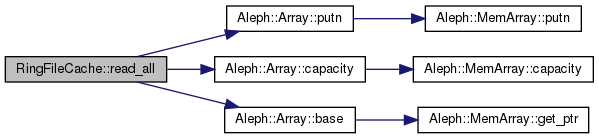
◆ read_all()
read all the entries
- Returns
- an dynamic and contiguous array with all the entries of the cache
◆ read_from() [1/2]
read m entries from the pos-th older position.
The returned array size indicates how many entries were effectively read.
◆ read_from() [2/2]
read m entries from the pointer older position.
The returned array size indicates how many entries were effectively read.
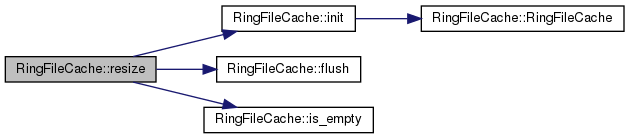
◆ resize()
Resize the maximum capacity of the cache.
Currently only the size increase is implemented.
- Parameters
-
- Exceptions
-
| domain_error | if sz is lesser than the current capacity |
| std::ios_base::failure | if there is a failure in any file |
◆ test()
template<typename T>
| static bool RingFileCache< T >::test |
( |
const string & |
pars_fname | ) |
|
|
inlinestatic |
Tests if pars and cache files have been created.
- Parameters
-
| [in] | pars_fname | name of parameters file |
- Returns
- true if pars_fname exists and its associated cache file exists too.
The documentation for this class was generated from the following file:



 Here is the caller graph for this function: