 |
Aleph-w
1.9
General library for algorithms and data structures
|


|
|
Aleph-w
1.9
General library for algorithms and data structures
|
|
#include <tpl_rand_tree.H>
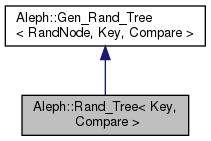
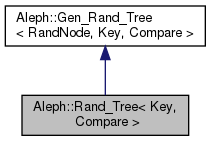
 Inheritance diagram for Aleph::Rand_Tree< Key, Compare >: Collaboration diagram for Aleph::Rand_Tree< Key, Compare >:
Public Types | |
| using | Base = Gen_Rand_Tree< RandNode, Key, Compare > |
| using | Node = RandNode< Key > |
Public Member Functions | |
| Compare & | key_comp () noexcept |
| return the comparison criteria | |
| Compare & | get_compare () noexcept |
| gsl_rng * | gsl_rng_object () noexcept |
| Get a pointer to gsl random number generator. | |
| void | set_seed (unsigned long seed) noexcept |
| Set the random number generator seed. | |
| void | swap (Gen_Rand_Tree &tree) noexcept |
Swap in constant time all the nodes of this with tree | |
| Node * | insert (Node *p) noexcept |
| Node * | insert_dup (Node *p) noexcept |
| Node * | remove (const Key &key) noexcept |
| Node * | search (const Key &key) const noexcept |
| Node * | search_or_insert (Node *p) noexcept |
| bool | verify () const |
Return true if this is a consistent randomized tree. | |
| Node *& | getRoot () noexcept |
| Return the tree's root. | |
| Node * | select (const size_t i) const |
| size_t | size () const noexcept |
| Return the number of nodes that have the tree. | |
| std::pair< long, Node *> | position (const Key &key) noexcept |
| std::pair< long, Node *> | find_position (const Key &key) noexcept |
| Node * | remove_pos (const size_t i) noexcept |
| bool | split_key (const Key &key, Gen_Rand_Tree &t1, Gen_Rand_Tree &t2) noexcept |
| void | split_key_dup (const Key &key, Gen_Rand_Tree &t1, Gen_Rand_Tree &t2) noexcept |
| void | split_pos (size_t pos, Gen_Rand_Tree &t1, Gen_Rand_Tree &t2) noexcept |
| void | join (Gen_Rand_Tree &t, Gen_Rand_Tree &dup) noexcept |
| void | join_dup (Gen_Rand_Tree &t) noexcept |
| void | join_exclusive (Gen_Rand_Tree &t) noexcept |
Randomized binary sarch tree.
This class implements a randomized binary search tree. It is shown that this type of tree always is equivalent to a classic binary search tree built from a random insertion sequence. Consequently, all the operations of this tree are  expected case, independentely of insertion order and of removals are interleaved with insertions.
The principle of this tree is balancing by taking random decisions whose probabilities guarantee that each node will have a chance of  for becoming the root of the tree.
In addition, these trees support select() and position() operations. That is, their keys can be accessed according to their inorder position and logarithmic time. This allows to treat the tree as if it was an array.
This tree type is unbeatable when there are splits and and especially joins operations on very large and independent data sets. Other tree types perform the join of independent data sets in  , where
  and
and  are the size of two data sets, while the randomized approach takes
  .
.
The class internally uses the gsl random number generator of GSL - GNU Scientific Library. By default, the Mersene twister is used and the seed is taken from system time.
|
inlinenoexceptinherited |
Find the inorder position of a key in the tree.
find_position(key) determines the inorder position that has or had key in the tree. Themethod return a tuple with a position and a node pointer.
If key is found then its inorder position is returned along with a pointer to the node containing it.
Otherwise, the the tuple returns the position that would have key if this was in the tree and the parent node that the key would had. At this regard, there are three cases:
key is lesser than the minimum key of tree, then first is -1 and the node is one with the smallest key.key is greater than the maximum key in the tree, then first is the number of keys and the node is one with the maximum key in the tree.key if this was in the tree and second is the node whose key is inmediataly greater than key.| [in] | key | to be searched |
|
inlinenoexceptinherited |
This is an overloaded member function, provided for convenience. It differs from the above function only in what argument(s) it accepts.
|
inlinenoexceptinherited |
Insert a node in the tree
| [in] | p | pointer to the node to insert |
p->get_key() is not in the tree, then the pointer p is returned (it was inserted); othewise, nullptr is returned
|
inlinenoexceptinherited |
Insert a node in the tree.
This method does not fail. It always inserts.
| [in] | p | pointer to the node to insert |
p pointer
|
inlinenoexceptinherited |
Join this with t filtering the duplicated keys
join(t, dup) produces a random tree result of join of this and t. The resulting tree is stored in this.
Nodes containing duplicated keys are inserted in the randomized tree dup. The nodes could belong to any of two trees
| [in] | t | ramdomized tree to join with this |
| [out] | dup | ramdomized tree where nodes containing duplicated keys are inserted |
|
inlinenoexceptinherited |
Join this with t independently of the presence of duplicated keys
join(t) produces a random tree result of join of this and t. The resulting tree is stored in this.
| [in] | t | ramdomized tree to join with this keys are inserted |
|
inlinenoexceptinherited |
Join exclusive of this with t
Exclusive means that all the keys of this are lesser than all the keys of t. This knowlege allows a more effcient way for joining that when the keys ranks are overlapped. However, use very carefully because the algorithm does not perform any check and the result would be incorrect.
| [in] | t | ramdomized tree to exclusively join with this keys are inserted |
|
inlinenoexceptinherited |
Compute the inorder position of a key
| [in] | key | to be searched |
key is not in the tree, then first the first value is -1.
|
inlinenoexceptinherited |
Remove a key from the tree
| [in] | key | to remove |
key was found in the tree, nullptr otherwise
|
inlinenoexceptinherited |
Remove the key at inorder position i
| [in] | i | inorder position to be removed |
| out_of_range | if i is greater or equal than the number of nodes of tree |
|
inlinenoexceptinherited |
Search a key.
| [in] | key | to be searched |
nullptr
|
inlinenoexceptinherited |
Search or insert a key.
search_or_insert(p) searches in the tree the key KEY(p). If this key is found, then a pointer to the node containing it is returned. Otherwise, p is inserted.
| [in] | p | node containing a key to be searched and eventually inserted |
p is found, then a pointer to the containing key in the tree is returned. Otherwise, p is inserted and returned
|
inlineinherited |
Return the i-th node in inorder sense
| [in] | i | inorder position to be located |
| out_of_range | if i is greater or equal that the number of nodes |
|
inlinenoexceptinherited |
Split the tree according to a key
| [in] | key | for splitting |
| [out] | t1 | tree with keys lesser than key |
| [out] | t2 | tree with keys greater than key |
true if tree was split; that is if key is not in the tree. Otherwise, if key is in the tree, false is returned
|
inlinenoexceptinherited |
Split the tree according to a key that could be in the tree
split_dup(key, t1, t2) splits the tree according to key in two trees t1 which contains the key lesser than key and t2 which contains the keys greater or equal than key.
| [in] | key | for splitting |
| [out] | t1 | resulting tree with the keys lesser than key |
| [out] | t2 | resulting tree with the keys greater or equal than key |
|
inlinenoexceptinherited |
Split a extended binary tree according to a position
split_pos(pos, ts, tg) splits the tree two trees t1 and t2 according to a position pos. t1 contains the keys from 0 to pos - 1 inorder sense and tg the keys from pos to n -
this becames empty.| [in] | pos | position for splitting |
| [out] | t1 | tree where the rank of keys  will be put will be put |
| [out] | t2 | tree where the rank of keys ![$[i, n]$](form_24.png) will be put will be put |