 |
Aleph-w
1.9
General library for algorithms and data structures
|


|
|
Aleph-w
1.9
General library for algorithms and data structures
|
|
#include <tpl_union.H>
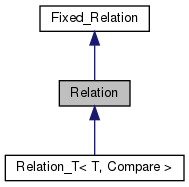
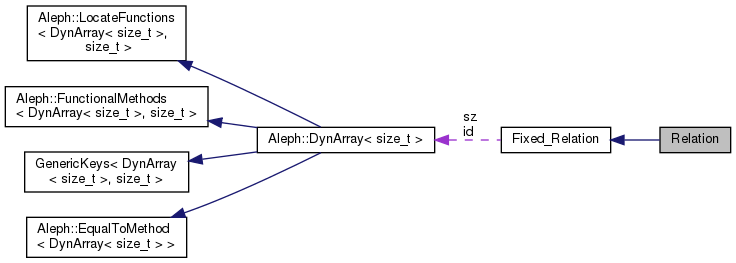
 Inheritance diagram for Relation: Collaboration diagram for Relation:
Public Member Functions | |
| Relation (size_t n=0) | |
| Intialize an empty relation of n elementos between [0..n) | |
| void | set_n (size_t n) |
| size_t | size () const noexcept |
| Return the number of items of set (not of relation) | |
| size_t | get_num_blocks () const noexcept |
| bool | are_connected (size_t i, size_t j) noexcept |
| void | join (size_t i, size_t j) noexcept |
Protected Member Functions | |
| size_t | depth (size_t i) noexcept |
Protected Attributes | |
| DynArray< size_t > | id |
| DynArray< size_t > | sz |
| size_t | num_blocks |
Binary relation between a set of integers.
This class implements a dynamic relation of equivalence between a set of n integer from 0 until n - 1.
By static is understood that the number of items can grow.
The used algorithm is the quick weighted fast union which is very fast, bounded by  but in the practice trends to be
  .
.
This implementation is strongly based on java version of Sedgewick and Wayne
|
inlinenoexceptinherited |
Return true if item i is related to item j.
Note since the relation is symmetric saying that i is related to j is the same thing than saying that j is related to i.
Basically i is related to j if it is possible to reach 'j` from 'i'.
| [in] | i | an item index |
| [in] | j | an item index |
i is related to j; false otherwise Here is the caller graph for this function:
|
inlinenoexceptinherited |
Return the number ob connected blocks, which is the number of equivalence classes
|
inlinenoexceptinherited |
Insert the pair '(i,j)' in the relation. All the reachability state is updated.
| [in] | i | an item index |
| [in] | j | an item index |
Here is the caller graph for this function:
|
inlineinherited |
Set the number of items of the relation.
The advantage of this method is that it allows to construc A Fixed_relation without need forknowing the number of items. Afterward, when threse are known this number could be set with this method.
| [in] | n | the number of items. |
| bad_alloc | if there is no enough memory |
Here is the call graph for this function: