 |
Aleph-w
1.9
General library for algorithms and data structures
|


|
|
Aleph-w
1.9
General library for algorithms and data structures
|
|
#include <tpl_union.H>
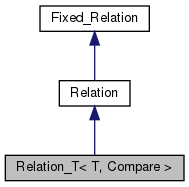
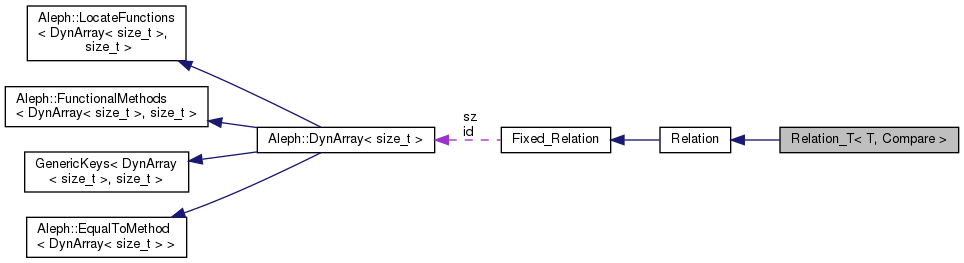
 Inheritance diagram for Relation_T< T, Compare >: Collaboration diagram for Relation_T< T, Compare >:
Public Member Functions | |
| bool | are_connected (const T &p, const T &q) |
| Retorna true is i y j están conectados. | |
| void | join (const T &p, const T &q) |
| Une p con q. | |
| void | set_n (size_t n) |
| size_t | size () const noexcept |
| Return the number of items of set (not of relation) | |
| size_t | get_num_blocks () const noexcept |
| bool | are_connected (size_t i, size_t j) noexcept |
| void | join (size_t i, size_t j) noexcept |
Protected Member Functions | |
| size_t | depth (size_t i) noexcept |
Protected Attributes | |
| DynArray< size_t > | id |
| DynArray< size_t > | sz |
| size_t | num_blocks |
Binary relation between a set of integers.
This class implements a dynamic relation of equivalence between a set of n different items of type T
The used algorithm is the quick weighted fast union which is very fast, bounded by  but in the practice trends to be
  .
.
This implementation is strongly based on java version of Sedgewick and Wayne
|
inlinenoexceptinherited |
Return true if item i is related to item j.
Note since the relation is symmetric saying that i is related to j is the same thing than saying that j is related to i.
Basically i is related to j if it is possible to reach 'j` from 'i'.
| [in] | i | an item index |
| [in] | j | an item index |
i is related to j; false otherwise Here is the caller graph for this function:
|
inlinenoexceptinherited |
Return the number ob connected blocks, which is the number of equivalence classes
|
inlinenoexceptinherited |
Insert the pair '(i,j)' in the relation. All the reachability state is updated.
| [in] | i | an item index |
| [in] | j | an item index |
Here is the caller graph for this function:
|
inlineinherited |
Set the number of items of the relation.
The advantage of this method is that it allows to construc A Fixed_relation without need forknowing the number of items. Afterward, when threse are known this number could be set with this method.
| [in] | n | the number of items. |
| bad_alloc | if there is no enough memory |
Here is the call graph for this function: